Bukchon has visiting hours because Jongno-gu, its district office, made it so. Specific alleys are closed to visitors between 5pm and 10am. People live full-time in the hanok here, and the restriction protects their evenings. Break it and a fine is possible — not just disapproval.
What Bukchon actually is
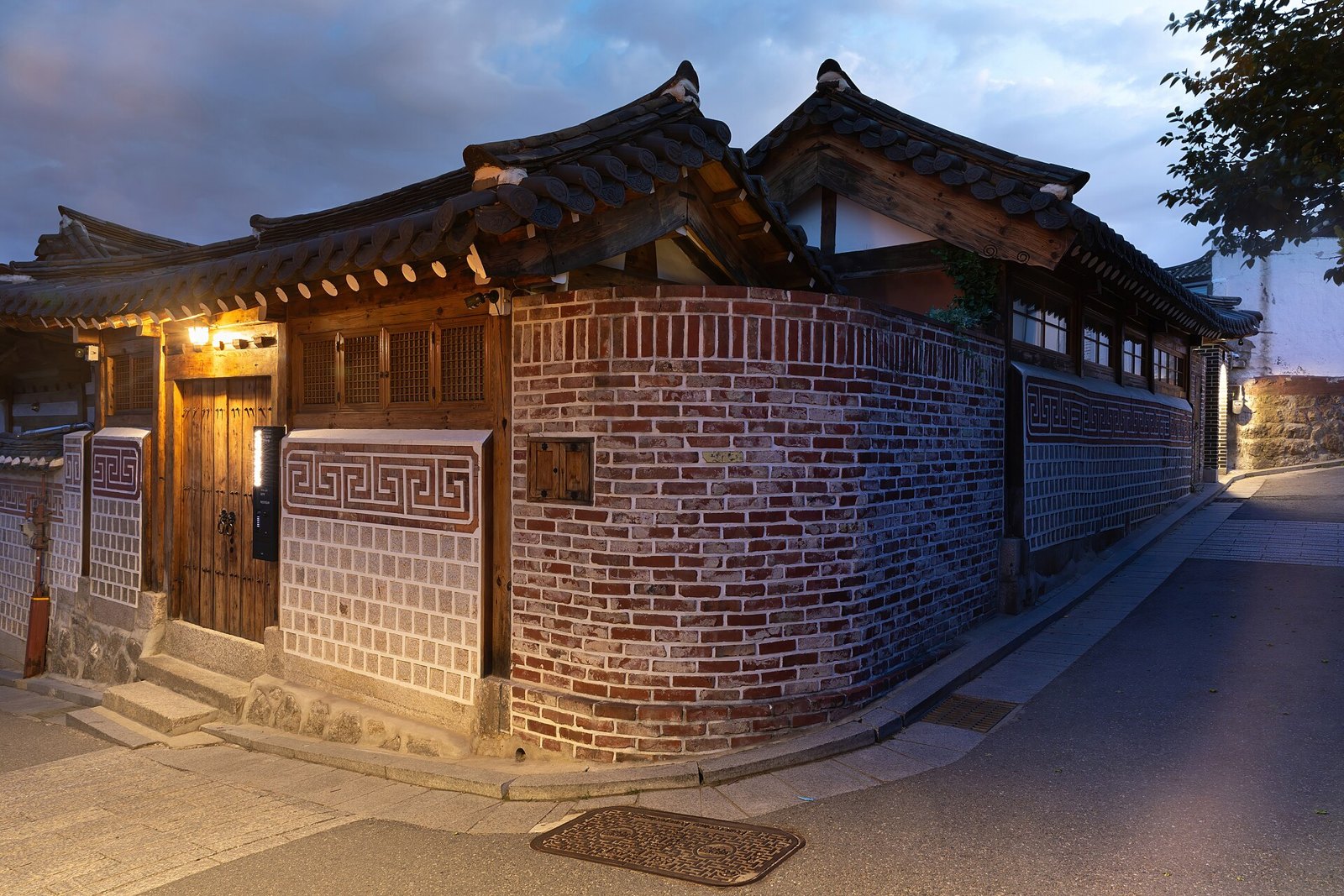
Bukchon (북촌, “north village”) sits between two palaces in Jongno-gu: Gyeongbokgung to the west, Changdeokgung to the east. The name covers several neighborhoods (-dong), not one street. Joseon-era officials who worked at the nearby palaces built their houses here, and the hanok they left behind are mostly still private homes.
Seoul’s city government has registered parts of Bukchon as a hanok preservation district, limiting what owners can build or renovate. That rule is why the streetscape survived while most of central Seoul rebuilt in concrete and glass.
The rule: which alleys, which hours
Jongno-gu’s restriction does not cover all of Bukchon. It targets the narrow residential lanes that became the most photographed — above all the alleys off Bukchon-ro 11-gil in Gahoe-dong, the steep street that shows up in nearly every photo of the district. Jongno-gu designated this stretch and its connecting cul-de-sacs as off-limits to visitors overnight, under a district ordinance first reported around 2018.
- Bukchon-ro 11-gil and its side alleys (Gahoe-dong): closed to non-residents from 5pm to 10am, daily, according to Jongno-gu’s own signage.
- Residential cul-de-sacs marked “no entry” or “quiet please”: the same hours apply wherever the sign is posted — the sign is the rule, not the street name.
- Bukchon-ro itself, Gahoe-ro, and Samcheong-ro: these are public through-roads, not residential lanes. No visiting-hours restriction applies on them.
- The approach from Anguk Station: also unrestricted. It’s a public street the whole way to the main viewpoint.
So the rule is narrower than it sounds. It targets a handful of named lanes, not the whole neighborhood, and the main photographed street — Bukchon-ro 11-gil — is exactly the one it covers.

The fine
Jongno-gu’s ordinance, as reported when it was introduced in 2018, set a maximum fine of ₩100,000 for noise or trespass in the restricted hours. Statutory fines get revised; confirm the current figure on Jongno-gu’s own site before assuming that number still holds. The policy itself was covered at the time by outlets including the Korea Herald, reporting complaints from residents about tour groups, early starts and people photographing into open doorways.
How strictly it’s enforced varies, by most accounts. Treat the posted hours as the operative rule, not the odds of being caught.

Why this exists
Bukchon’s resident population is a fraction of what it was mid-century, but it is not zero, and the houses that remain are occupied, not curated. A hanok with thin walls and a street-facing gate gives very little privacy against a visitor standing in the alley at 7am with a camera. The hours rule is Jongno-gu’s answer to a specific, recurring complaint, not a general crackdown on tourism.
What’s still free, and where the money actually goes
None of this touches the palaces on either side of Bukchon. Entry to Gyeongbokgung and Changdeokgung runs about the price of a coffee each, and anyone wearing hanbok gets in free — a standing policy at every palace and at Jongmyo, not a promotion that ended. Rental shops for hanbok cluster around both Gyeongbokgung and Bukchon itself. See our guide to how free hanbok entry actually works for the fine print.
The two palaces also close on different days — Gyeongbokgung on Tuesday, Changdeokgung on Monday — which matters if a visit to Bukchon is meant to bookend a palace stop. The full breakdown is in our rundown of which palace closes which day. Anyone planning to visit more than two palaces in a trip should also check when the integrated palace ticket pays for itself before buying single tickets.

Getting there and getting out
Bukchon is usually reached from Anguk Station on Line 3; exit numbers there determine which side of the street you surface on, not just which neighborhood, so it’s worth reading how Seoul’s subway exit numbers work before relying on an exit number alone. Seoul’s subway and bus network is covered more broadly in our Getting Around archive.
Last trains vary by line and direction and are posted at the station, not fixed citywide — check the figure at working out a real last-train cutoff rather than assuming midnight everywhere. General trip-planning notes, including how to handle Seollal and Chuseok closures that affect the whole city, sit in our Planning & Practicalities archive.
The short version
Bukchon is a functioning neighborhood with a narrow, named restriction attached to it — specific alleys around Bukchon-ro 11-gil, closed 5pm to 10am, with a published maximum fine behind it. The main streets — Bukchon-ro, Gahoe-ro, Samcheong-ro, the walk up from Anguk Station — carry no such rule. Reading a “no entry” sign as a real instruction, not a suggestion, covers the rest.
How this site sources and checks claims like the one above is set out on our About page; what we collect when you read it is on our privacy policy.
Access Seoul is an independent guide written from published, checkable sources. We have not visited the places described here and we do not publish personal recommendations or invented ‘local favorites’ — where something is singled out as notable, we say who says so. Opening times, fares, closures and prices change at short notice, so treat everything here as a starting point and confirm with the museum, operator or venue directly before building a day around it. We give no advice on visas, insurance, health or safety; use your own government’s official guidance for those.
Featured image: Photo by Basile Morin, source, CC BY-SA 4.0
